
The Future of Business Ownership Is Getting More Interesting
From employee ownership to businesses that fund purpose, founders have more succession paths worth exploring. Here is a practical look at who owns, who decides, and who benefits.
The Future of Business Ownership is Getting More Interesting
Commonly we think of 4 different alternative business models but a fifth is emerging.
A founder can spend years building a business that people love, a workplace people count on, and a real contribution to a community. Then comes a question with enormous consequences: who should own it next?
The answer deserves room to breathe.
Employee ownership. A purpose trust. A buyer who understands the mission. Each opens a different conversation about what can endure and who gets to benefit. And there is another path worth bringing into clearer view: a business owned by a nonprofit or foundation, with its economic value supporting a purpose beyond individual shareholders.
The 100% for Purpose movement brings visibility to businesses dedicating all their profits to charitable or social-impact causes. It gives founders another possibility to consider when imagining what comes next.
How foundation ownership can put profits to work
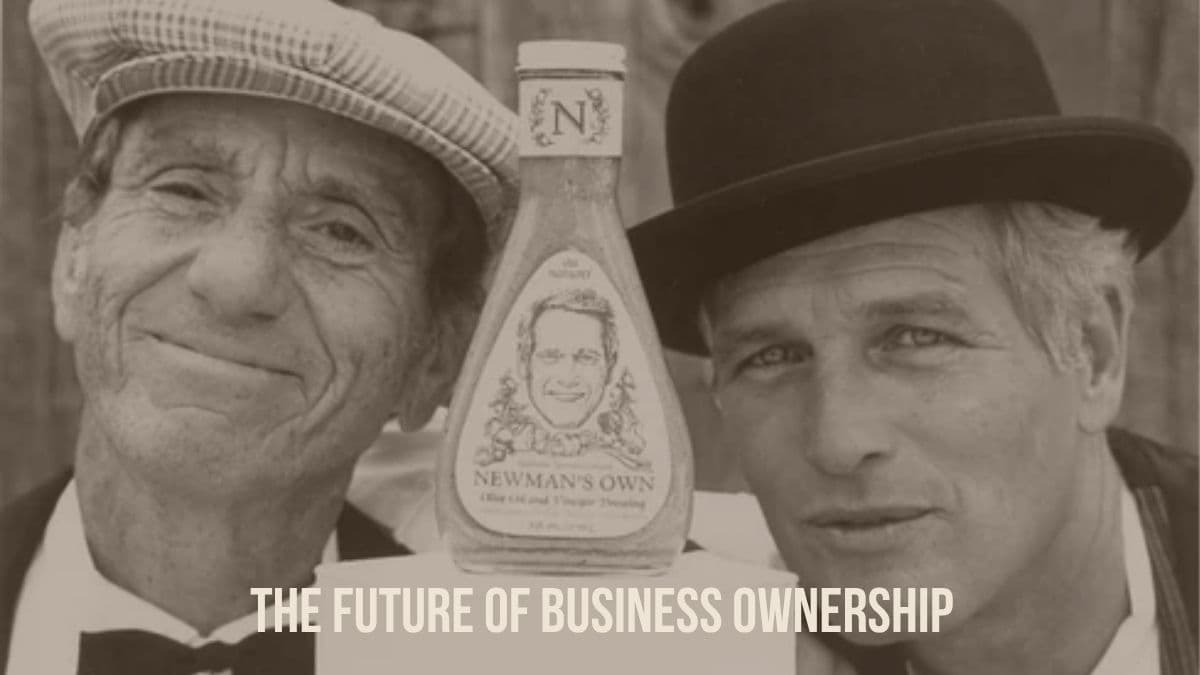
The Newman’s Own ownership model makes this idea tangible. The food company is a for-profit business wholly owned by Newman’s Own Foundation. Its profits support the foundation’s charitable work. The company pays employees, buys ingredients, markets products, and covers normal business expenses and taxes. What remains serves the mission.
This approach has deep roots. Newman’s Own has directed profits to good causes since 1982. The 100% for Purpose Club launched in January 2025, bringing fresh attention to a possibility that has been hiding in plain sight.
For a founder, it invites a compelling question: could the business you built become a continuing source of support for something you care about?
The answer will depend on the business, the founder’s needs, and the structure. But it belongs in the conversation.
Five ownership transition paths worth exploring
These are useful starting points, and they can overlap. They describe different choices about ownership, control, and the use of profits.
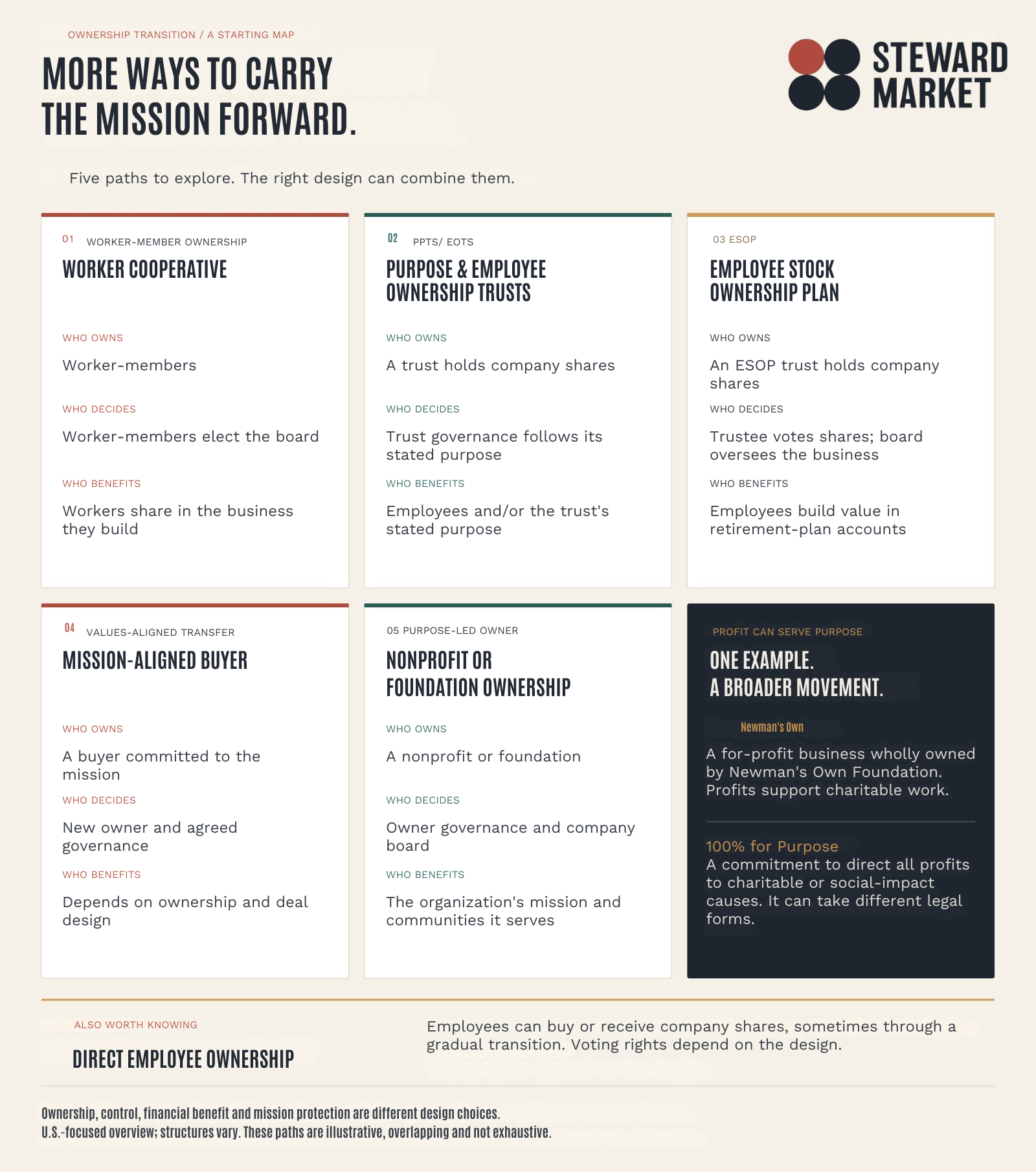
Five paths for ownership transition, with direct employee ownership as another option. Ownership, decision-making power, financial benefit, and mission protection are different choices; the right design can combine approaches.
Worker cooperatives
In a worker cooperative, worker-members own and democratically control the business, generally through one member, one vote. Members elect the board and share in the results of their work. For founders who want workers to have a meaningful voice in the business’s future, this is an important option.
Purpose and employee ownership trusts
A perpetual purpose trust can hold company shares to protect a defined mission over time. An employee ownership trust puts employee well-being among its purposes, sometimes alongside community or environmental goals. Governance and benefit-sharing depend on the trust’s design. Employees can benefit without individually buying or holding shares.
Employee stock ownership plans
In the United States, an employee stock ownership plan (ESOP) is a regulated retirement plan that holds company shares for employees. Employees build value through individual plan accounts, and an ESOP can support a partial or complete ownership transition. The trustee exercises shareholder rights; employee voting rights are generally limited unless the company provides more.
Mission aligned buyers
An aligned buyer may bring capital, experience, and a genuine commitment to the business’s future. The work is to understand how that commitment will show up after closing: in governance, financing, employee treatment, and operating decisions. Values create a starting point for discovery and diligence. The ownership and deal design determine what those intentions can support. Our guide to finding a buyer who will protect what you built offers practical questions to ask.
Nonprofit or foundation ownership
A nonprofit or foundation can own a business and use the economic benefits to advance its mission. Newman’s Own is one example. This is an ownership arrangement; 100% for Purpose describes a commitment about where profits go. The movement includes different legal structures and approaches.
Direct employee ownership offers another route
Through direct employee ownership, employees can buy or receive shares directly, sometimes through a gradual transition as the founder sells shares over time. Share ownership, voting rights, eligibility, and opportunities to sell shares need to be designed deliberately. It can create another route into employee ownership alongside cooperatives, ESOPs, and trusts.
How Patagonia combines purpose trust and nonprofit ownership
Patagonia’s ownership structure shows how these choices can work together. The Patagonia Purpose Trust holds all voting stock, representing 2% of the company. The nonprofit Holdfast Collective holds the other 98%, all nonvoting stock. The trust protects the company’s purpose; excess profits after reinvestment and reserves support environmental work through Holdfast. Patagonia remains a for-profit business.
That combination is a useful reminder to look closely at who holds decision-making power and who receives financial benefit.
Five questions to ask before choosing an ownership model
Before settling on a model, make room for five questions. Our Seller Stewardship Guide can help you clarify what you want to protect.
- Who will own the business, and can that ownership change again?
- Who will decide, including on the board and in major ownership decisions?
- Who will benefit financially, and when?
- What will protect the mission beyond the current people’s good intentions?
- How will the founder’s transition, employees’ participation, and the company’s future be financed?
How will the ownership transition be financed
A purpose-driven transition still needs a workable financial plan. A founder who needs sale proceeds will face different choices from one able to donate ownership. The U.S. private-foundation exception associated with Newman’s Own includes a requirement that the foundation acquire its ownership interests other than by purchase. That model should not be read as a ready-made funded buyout. The right legal, tax, and financing advisors can help evaluate the options for the particular business and jurisdiction.
Make the possibilities visible early
At Steward Market, we want founders to find aligned buyers, ownership pathways, advisors, and capital before their options narrow. That is why the marketplace makes values, intent, and fit visible from the start.
You do not need to arrive knowing exactly which structure is right. You do need a way to discover what is possible and connect with people who can help you explore it.
You can explore adopting a different ownership model for your business, or selling to a buyer already using one. Search Steward Market for buyers whose ownership models, values, and acquisition goals align with what you want to carry forward.
This Employee Ownership Month, you can see that possibility on Steward Market. A 100% ESOP-owned holding company is seeking New England businesses, with an approach centered on long-term stewardship and ownership opportunities for employees. Explore its buyer profile to learn about its acquisition criteria and consider whether it could fit the future you want for your business.
Other Articles You May Like

August 3, 2026
How to Find a Buyer Who Will Protect What You Built
Selling your business does not have to mean losing the employees, culture, mission, or community impact you worked to build. Here is how to define what matters, evaluate different buyer types, explore employee ownership, and find a buyer capable of becoming the company’s next steward.
August 19, 2026
We Built Better Businesses. Now We Need Better Ways to Transfer Them.
The social enterprise movement has spent decades building businesses that create value for workers, communities, and the planet. Now we need better buyers, ownership models, capital, and marketplaces to help those businesses transfer without losing what made them different.